
You know the moment. Doors are about to open, the first visitors are already waiting, and the entrance starts creating exactly the stress you wanted to avoid. A scanner hesitates, the guest list still lives in a spreadsheet, and staff have to improvise while the line grows.
A strong event access control system is not a luxury for temporary events. It is the operational layer between ticket sales, safety, visitor flow and the first impression of your event. A festival, conference or concert needs something different from an office building: less permanent infrastructure, more flexibility and a team that can act immediately on event day.
A smooth start for your event
The first scan often sets the tone. If visitors move through smoothly, the whole organization feels controlled. If they have to search for a QR code, argue about a name on a list or join another queue, the day starts with friction.

Temporary events often fail when teams copy building access logic into an event environment. An office needs stable long-term permissions. An event needs peak capacity, last-minute guest list changes and fast processing of many visitors in a short time.
What visitors notice when entry is weak
- Long queues: people enter late, miss the opening or arrive irritated.
- Uncertain staff: hosts switch between paper lists, phones and visitor questions.
- More disputes at the gate: duplicate tickets, forgotten tickets and wrong entrances cost time.
- Broken flow: once one lane slows down, the entire entrance becomes unstable.
An entrance does not need to be impressive. It needs to be predictable.
How an access control system works
Think of an event access control system as a key, a lock and a reception desk. The visitor has the key, such as a QR ticket or RFID wristband. The scanner or reader is the lock. The software decides whether access is allowed.
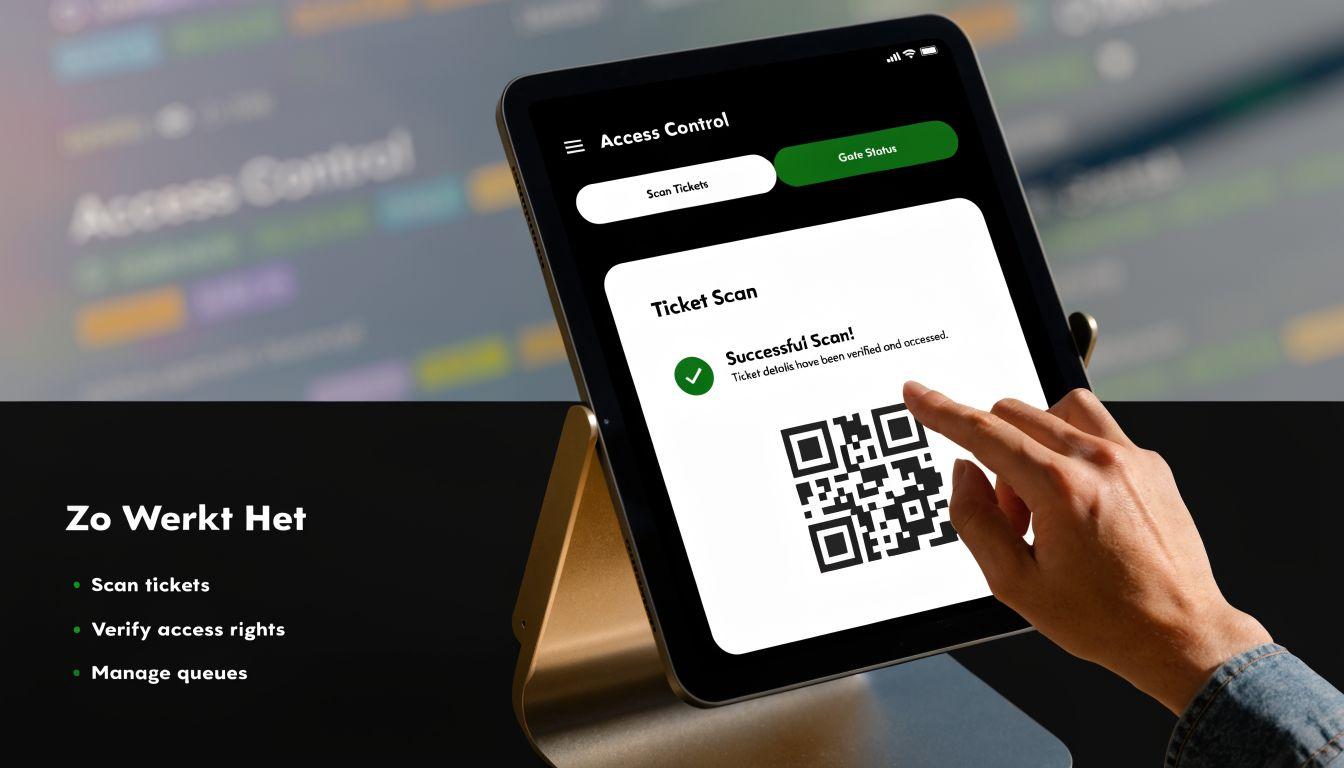
That cooperation has to keep working under pressure, especially when you have multiple entrances, different ticket types or a mix of public visitors, crew and VIP guests.
The three parts that always matter
1. The reader This is where the visitor identifies themselves. It can be RFID, NFC, biometrics or a mobile scan. For most events, QR scanning on a phone or tablet is the most practical form because it requires little fixed hardware.
2. The controller This is where the decision happens. The validation layer checks whether a ticket exists, is active, has not already been used and is valid for this entrance. For temporary events, speed and resilience matter more than heavy permanent hardware.
3. The software The software manages rights, ticket statuses, guest lists and logs. A practical event access control setup is therefore not only about scanning. It is also about live control during the event.
What happens during one scan
- The identifier is read A QR code, NFC tag or other token is scanned.
- Validity is checked The system checks whether the ticket exists, is active and has not been used.
- The access rule is applied The software checks whether this ticket is valid at this entrance and at this time.
- Staff get instant feedback Green for access, red for blocked, with a clear reason when something is wrong.
The best entry solution is the one a new team member understands in minutes.
Types of access control for events
Not every system fits every event. The right choice depends on visitor flow, event duration, access levels and how often you need to change something on site.
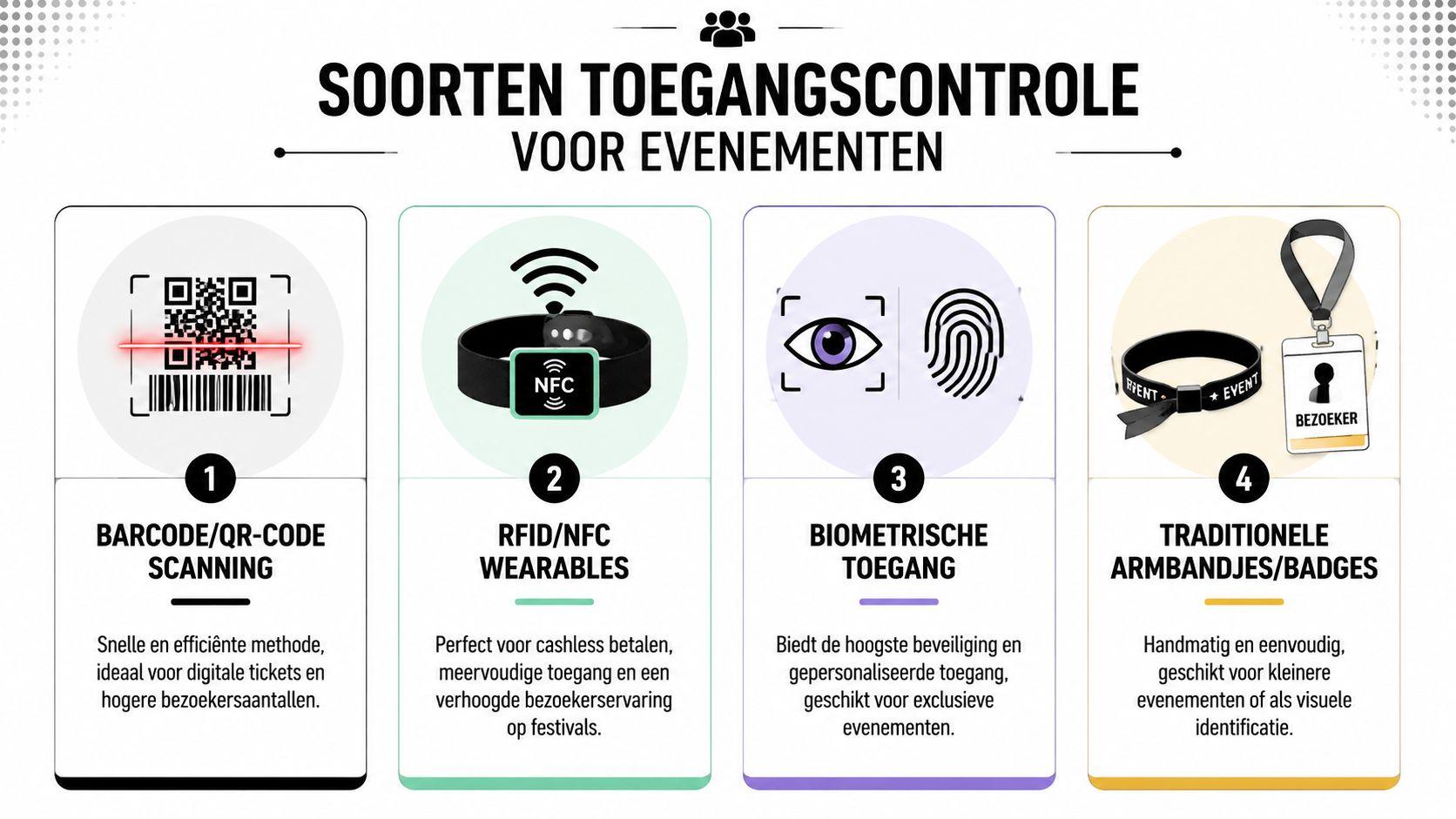
QR codes and mobile scanning
This is the logical starting point for many organizers. Visitors receive a digital ticket and staff scan it with a phone or dedicated device. It is fast to deploy and works well for concerts, conferences and club nights.
RFID and NFC wearables
RFID or NFC wristbands become stronger when access is part of a broader event flow, such as multi-day festivals, backstage zones, cashless payments or repeated entry. The tradeoff is more preparation before doors open.
Biometric access
Biometrics are rarely needed for a standard public entrance, but they can be useful for sensitive zones. They add hardware, registration and privacy questions, so they are usually a supplement rather than the default.
Badges and wristbands
Traditional badges and wristbands remain useful as a visual layer on top of digital validation. They are practical for crew, suppliers and press, but weak as the only control method for larger events.
| System type | Strengths | Tradeoffs | Best fit |
|---|---|---|---|
| QR scanning | Fast setup, flexible, good for digital tickets and guest lists | Depends on screen quality and visitor readiness | Concerts, conferences, club events |
| RFID/NFC | Strong for repeat access, zones and festival operations | More preparation and hardware | Multi-day festivals and cashless concepts |
| Biometrics | Strict identity control | More complex and privacy-sensitive | VIP, backstage, secure zones |
| Badges and wristbands | Clear visual recognition | Weak as the only validation layer | Crew, press, small events |
| Turnstiles | Physical flow control | More build time, space and coordination | Large entrances with fixed routing |
Do not choose the most advanced system. Choose the one that fits your busiest half hour.
Benefits for your event operation
The value is not the technology itself. The value is what does not happen on event day: no queue because a list is outdated, no argument over duplicate tickets and no entrance that takes an hour to stabilize.

Shorter queues and calmer staff
A good access flow removes pressure from your team. Staff search less, explain less and solve fewer exceptions manually. Visitors move faster and front-of-house staff can focus on real issues.
Better fraud prevention
Ticket fraud often starts with duplicated PDFs, forwarded confirmations or screenshots that were already used. Realtime validation gives your team a clear answer immediately, which reduces debate at the gate.
Useful operational data
Every scan is also a signal. You see when the peak starts, which entrance is slowing down and which groups arrive later than expected.
- Entrance load: see where queues are forming.
- Arrival patterns: plan hosts, security and bars more accurately.
- Ticket behavior: understand which ticket types arrive early or late.
- Problem categories: duplicate scans, wrong tickets and wrong entrances become visible.
Connect access control with ticketing and CRM
Standalone access control can work. Integrated access control works better. Once ticketing, entry and CRM are part of one workflow, a lot of event-day manual work disappears.
A sold ticket should automatically become a unique access credential. Not through exports, separate lists or manual imports, but directly from the same system. That keeps scan status, ticket type and visitor profile connected.
When ticketing and access are connected, the scan team works with live data, even when something changes shortly before opening. CRM adds another layer: entry is no longer only about letting people in, but also about improving audience data for follow-up, segmentation and future campaigns.
Tiqqo brings ticketing, mobile scanning and CRM into one environment. For organizers who do not want to manage a stack of disconnected tools, that keeps sales, validation and customer profiles in the same workflow.
Costs and implementation
The cost of an access control system is rarely only the purchase price. For events, look at total cost of ownership: preparation, support, training, maintenance, storage, hardware and operational complexity.
Temporary events use systems for peaks, not daily building management. Heavy hardware investments are often less logical when your main challenge is a short high-pressure entry window.
| Model | Characteristic | Usually fits |
|---|---|---|
| Hardware-heavy | Higher upfront investment, more physical components, more maintenance | Fixed venues and permanent installations |
| Hosted software model | Lower entry point, costs linked to use or ticket volume | Temporary events and changing productions |
If you want to compare costs clearly, compare the full model, not only the device price. The event software and ticketing pricing page is a useful starting point for that discussion.
Privacy and choosing the right setup
The best choice usually starts with your event model, not with hardware. A one-day conference needs something different from a multi-day festival site.
- Event type: seated, open access, time-slot based or multi-day?
- Visitor flow: one peak or spread-out arrival?
- Access levels: public only, or also crew, artists, VIP and suppliers?
- Flexibility: can you change guest lists and rights on the day?
- Integrations: should access connect to ticketing, CRM or communication?
Privacy matters as soon as scan data is tied to individuals. You need to know what data you collect, why you collect it, how long it is kept and who can access it. For organizers using entry data for relationship management, it is worth checking how a platform handles GDPR and data ownership for event organizers.
A good event access control system does two things at the same time. It keeps entry smooth and keeps your organization credible. That is what visitors, partners and your own team need on event day.